

Books
Comprehensive Learner Books for Each Stage.
Designed to use Everyday, in Every Classroom.
Science Book Overview
Our Science series is based on the Cambridge Primary Science (0097) Curriculum Framework. The books provide a comprehensive resource and learner programme for Cambridge International Primary learners. It is also ideally suited as an extension series set at an internationally recongised standard.
Mathematics Book Overview
Our Mathematics series focuses on supporting the teacher following the Cambridge Primary Mathematics (0096) Curriculum Framework. It is ideally suited as an extension series set at an internationally recognised standard.
English Book Overview
Our English series is designed strategically; to provide an integrated and varied range of integrated learning material, for each learner following the Cambridge Primary English (0058) Curriculum Framework. It is also ideally suited as an extension series set at an internationally recognised standard.
KEY FEATURES OF OUR SERIES



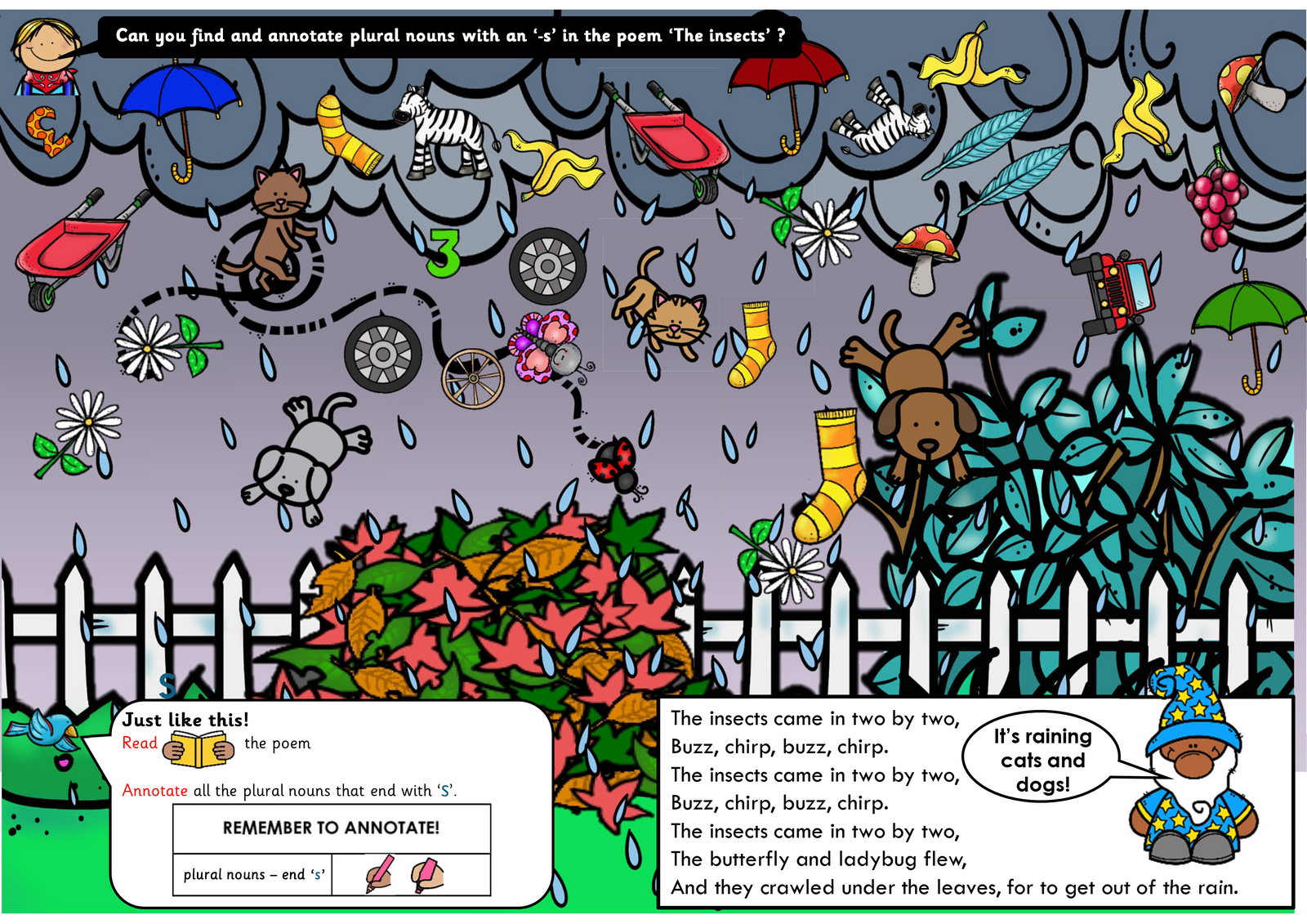
Speech bubble characters provide:
- ‘Can you’ questions; refer explicitly to the Learner Success Criteria per objective.
- Help students to plan strategies and ways of monitoring their progress towards achieving these goals [metacognition].
- Supporting information.
- ‘Just like this!’ provides instructions, examples, or method.

The quarter segments character provides a space for the teacher to record and determine what scaffolding is still required for the learner to achieve mastery.
The following examples serve to display the variety and scope of material that provides a comprehensive spiral approach across the three core subjects.
 Prior Knowledge
Probe for GAPS.
Ensure that the prior related concept and vocabulary is remembered and understood.

Objective Introduction

A presentation of clear and correct content and vocabulary for objectives.
Provide a reference for learners as well as a pivot point for modelling and scaffolding.

Rehearsal – Spaced Practice – Ebbinghaus (1885; Memory)

Reloading memory strengthens neural pathways (myelination).
Rehearsal allows objectives to be correctly practiced in a variety of ways, to increase recall and understanding.

Review – Integration

Storage of ‘content and skills’ is useless; unless it can be accurately & speedily retrieved – on demand.
Designed to practice accurate and speedy retrieval and application of ‘content and skills’, on demand.

Review – Integration

Focussed on activities which involve analysing, evaluating, and creating , based on the objectives covered, at that point.

Self-evaluation [Metacognition]

Self – regulation ‘learning to think’& ‘thinking to learn’
Allows learners to assess their own learning at intervals throughout each book.
Our series is designed to develop knowledge, understanding, and application through a spiral approach, by rehearsal and scaffolded practice of topics and skills, in more depth within a stage and at each successive stage. To further strengthen the series, we focus on the following learning and teaching principles.
ACTIVE LEARNING Whoever is doing the work; is doing the learning – over a period of time.
Learners engage in the learning process; as knowledge transfers from ‘short to long-term memory and is incorporated into progressively more detailed and sophisticated mental models called schemas or schemata. Schemata can be thought of as categories we use to classify incoming information.’ (Wadsworth,1996.p16)
Your role as teacher is vital to laying a clear, correct and secure knowledge base that can lead to understanding. By providing a wide range of review activities that engage the learner to construct new skills and knowledge – bit by bit – layer by layer – based on clear and correct PRIOR KNOWLEDGE.
Begin by establishing their prior knowledge the learner can make links between their existing knowledge and the new . Never assume that prior knowledge exists – this includes vocabulary.
New skills and knowledge must be not only be linked to prior knowledge but also be modelled in small steps with many activities and tasks for thorough scaffolded practice, rehearsal and spaced review over time.
MODELLING – DIRECT INSTRUCTION (present in small steps - at least three times in different ways)
As the model you give a clear and correct exemplar of the knowledge or skill. Explain what is expected of the learners at each small step; as they develop the skill or complete the related task.
Demonstrate exactly how each step is performed – whilst thinking aloud – exposing the overt [declarative] thinking that occurs with each step. Model ‘the how’ by thinking aloud whilst analysing the question posed and showing the skills to apply.
SCAFFOLDING
Scaffolding by the teacher is vital to ensure that the practice being done by the learner is not flawed. With your guidance the learner can build knowledge, practice skills or achieve goals, which would be beyond their independent efforts. By using questions to check and to deepen understanding is helpful to gauge the learner’s level or ZPD and provides you with next steps.
Your support and guidance, which may include re-modelling, questioning and feedback during rehearsal activities should be withdrawn, over time, as the learner processes and becomes more proficient. This allows for the learner to develop their mastery and independence. In addition, scaffolding allows the learners to develop planning, monitoring, and evaluation skills – metacognition.

Scaffolding learning is critical to secure the clear and correct knowledge and/or skills. Equally, support should be withdrawn over time and when appropriate, to allow students to develop independence.
Scaffolding Theory (Jerome Bruner)
Schemata can be thought of as categories we use to classify incoming information.
(Wadsworth, 1996, p.16).
Learners construct their understanding over time as information moves from short-term to long-term memory. A process of adding to, adapting, replacing, or incorporating prior knowledge bit by bit. As a result, more comprehensive and refined mental models called schemas are established. (schemata – singular)

BLOOM’S TAXONOMY (revised 2001)
The development of learners’ cognitive processes [from remembering to creating] are enhanced by questioning and feedback. As is the mastery of types of knowledge from factual and procedural to conceptual and metacognition or ‘learning to think & thinking to learn.’
TYPES OF KNOWLEDGE


ASSESSMENT for LEARNING
By sharing the learner success criteria in an accessible and engaging way [our Can you? Speech bubbles] and the quarter segments character that provides a space for the teacher to record and determine what amount and type of scaffolding and feedback is still required for the learner to achieve mastery.
Feedback needs to be related to the learning intention and success criteria set for each task. This will allow learners to use the feedback to improve. Feedback could focus on the content and quality of work, how a learner has approached a task, and/or the effectiveness of the strategy they chose.
THE CAN YOU…? SPEECH BUBBLE CHARACTER
‘Can you’ questions; refer explicitly to the Learner Success Criteria per objective.
THE QUARTER SEGMENT CHARACTER

METACOGNITION The Path To Self – Regulation - ‘Learning To Think’ & ‘Thinking To Learn’
- Express the strategies or ways that learners would use to monitor their own progress.
- For example, asking questions aloud while going through this Learner Success Criteria Sheet.
- Encourage the learners to talk about their progress toward mastery, confident practice and self-assessment.
- Help students to understand the goal of reaching the full objective by the end of the year.
- Try to keep learners within their zone of proximal development (ZPD)
- Model and or scaffold to small groups or individuals:
- Effective memory storage techniques; visual, auditory, and kinaesthetic strategies
- Classifying; sorting, ordering, and or categorising
- Paraphrasing, summarising, questioning, clarifying, deconstruction, evaluating, planning, predicting, creating and constructing.
- Model and then scaffold the use of metacognitive strategies by asking questions.
- What do I know about this task
- Have I done a task like this before
- What skills must I recall to complete this task?
- Have I learnt information in another subject that can help me with this task?
- Do I have the skills to complete the instructions?
- Do I have the equipment to complete this task?
